Trampoline park business plan: a practical guide

A trampoline park business plan is the document that proves, with your own figures, that the park can fill sessions, cover its costs and pay back the investment. It should cover the local market, location, revenue from sessions, parties and extras, opening and running costs, your safety plan and several financial scenarios.
What a trampoline park business plan should include
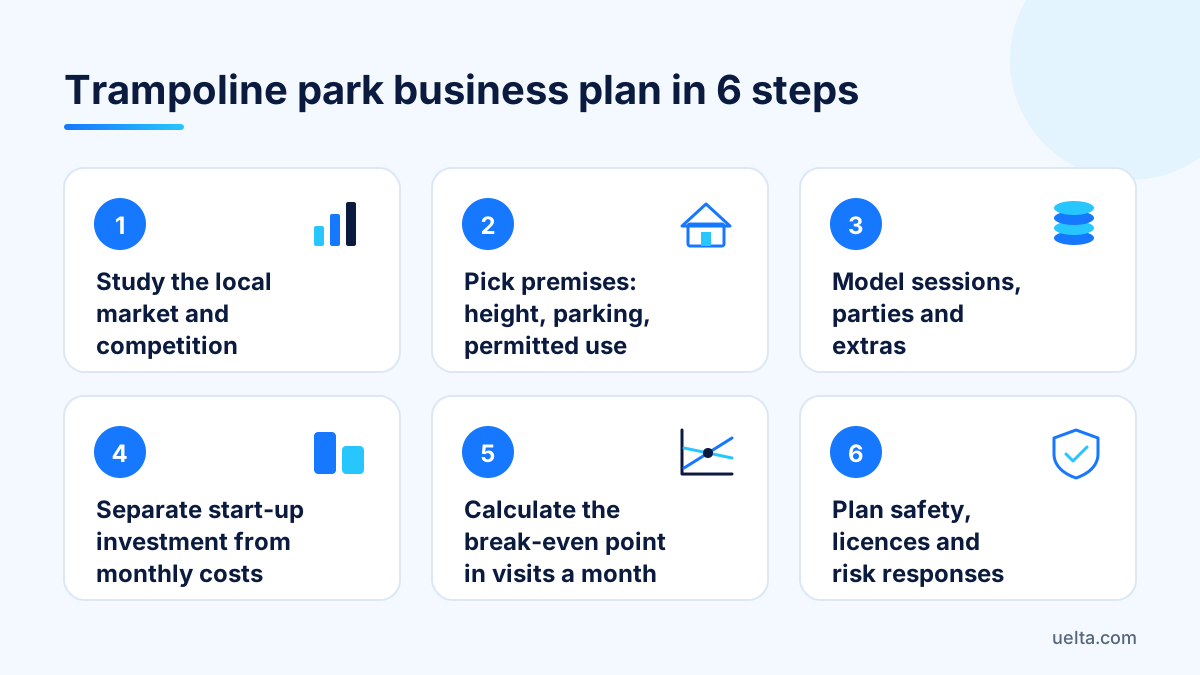
A bank, a partner or you yourself a year from now will read the plan looking for the same things: whether the numbers hold up and whether you have thought about what could go wrong. These sections are essential:
- Executive summary: what you are opening, where, for whom, how much you need and when you expect to recover the investment. Write it last.
- Market and competition: families, schools and teenagers in your catchment area and what other leisure options they have.
- Premises and layout: floor space, ceiling height and zones (trampolines, foam pit, toddler area, party rooms, reception, café if you have one).
- Offer and pricing: sessions, parties, groups, multi-visit passes and add-ons.
- Operations plan: opening hours, staff per shift, check-in process, cleaning, maintenance and safety.
- Marketing: where the first bookings will come from and how you will get people to return.
- Financial plan: start-up investment, revenue and cost forecast, monthly cash flow and break-even point.
- Risks: what you will do if occupancy is lower, the licence is delayed or a supplier lets you down.
Market and location: what decides whether sessions fill up
A trampoline park depends on families who can reach it in a short journey and on groups who choose it for a celebration. Before signing a lease, check these criteria:
- Target population nearby: how many households with children and teenagers live within a reasonable drive. Local council and census data give you a first picture.
- Parking and access: on a rainy Saturday, people who cannot park simply go elsewhere.
- Ceiling height and floor: trampolines and foam pits need height and a suitable slab. Ask the manufacturer for their requirements before choosing a unit.
- Permitted use: confirm with the council and a surveyor that the activity can be authorised in that building. Renting a cheap warehouse where the planning use does not fit is the most expensive mistake.
- Schools and clubs nearby: they are your source of weekday-morning groups, when families are not coming.
- Real competition: other parks, soft play, bowling and any weekend outing for families.
A useful exercise: visit competing venues on a Saturday afternoon and a Tuesday morning. Note session length, how they sell parties, which extras they offer and how busy they are. That information is worth more than any industry average.
Revenue: how to model sessions, parties and extras
The basic formula is simple: revenue per session = places × expected occupancy × average price. The hard part is not being optimistic. Follow these steps:
- Set the maximum capacity per session based on usable floor space and the safety rules you will apply.
- Choose session length (for example 60 or 90 minutes) and how many fit into each time band.
- Assign a hypothetical occupancy for each type of day: weekday, weekend, bank holiday and school holidays.
- Build three scenarios: cautious, realistic and good. If the cautious one does not cover fixed costs, the project needs changes.
- Use the real average price, after discounts, passes and spectator tickets.
- Add parties (rooms × slots per weekend), school and holiday-camp groups, and add-ons such as grip socks, drinks and party food as separate lines.
- Put everything into a monthly calendar: September looks nothing like December or July.
Typical mistake: applying Saturday occupancy to the whole week. Weekday mornings fill with groups and campaigns, not by themselves. Another is forgetting average spend: an add-on offered at the moment of booking often makes the difference between a tight month and a comfortable one.
Opening and running costs
Keep the start-up investment separate from monthly costs. Start-up investment includes:
- Fit-out of the premises, heating, ventilation and lighting.
- Trampolines, foam pit, padding and safety matting with their certification.
- Technical drawings, licences and fees.
- Reception, furniture, party rooms and equipment (tablet or computer, card terminal).
- Website, branding and launch campaign.
- Initial stock of grip socks, drinks and party food.
- A cash buffer for the first months, while bookings are not yet steady.
Monthly costs: rent, staff (marshals, reception, cleaning), insurance, utilities, maintenance and spare parts, management software, payment fees, ongoing marketing and accountancy. Staff is the line you can adjust most: plan rotas around expected occupancy in each time band, not around opening hours.
From this you get the break-even point: monthly fixed costs divided by the margin each visit leaves you. The result is the number of visits a month you need to avoid losing money, and it is the figure you will be asked about most.
Safety, regulation and risks
A trampoline park carries more exposure than many leisure venues, so the plan must show how you manage risk. Include at least:
- Activity licence, public liability insurance and visible rules of use.
- A waiver signed by every jumper, with the adult signing for their children.
- Safety briefing, marshals per zone and control of each session's time.
- Incident log and maintenance checks with a history.
- Staff working-time records, which are mandatory in Spain.
Requirements vary by country, region and local authority, so check your specific case with a legal and technical adviser before finalising the budget. For daily operations there is a detailed list in trampoline park safety rules. Close the section with a list of risks and responses: low occupancy (more weekday groups and campaigns), licence delay (an opening date with slack), a zone out of action (spare parts and planned maintenance).
Frequently asked questions
How long does it take to write a trampoline park business plan?
It depends on how quickly you get premises details, quotes for fit-out and equipment, and licence requirements. The writing is quick; validating each figure with real quotes is what takes time.
What is the main source of revenue for a trampoline park?
Jump sessions are usually the base, but parties, groups and add-ons are what improve the margin. Model them separately to see how much each contributes in your case.
How do I estimate occupancy before opening?
Start from maximum capacity, observe competitors on different days and apply cautious assumptions per type of day. Review them every month once you have real sales.
Should management software be in the business plan?
Yes, as a fixed monthly cost and as part of the operations plan. Online booking, front-desk sales, waivers and capacity control affect how many staff you need per shift.
How Uelta helps
Uelta gives you a clear fixed cost for the financial plan: 99 € a month + VAT, including online booking, ticket sales at the front desk and in the online shop, and birthday parties. For a trampoline park it fits like this:
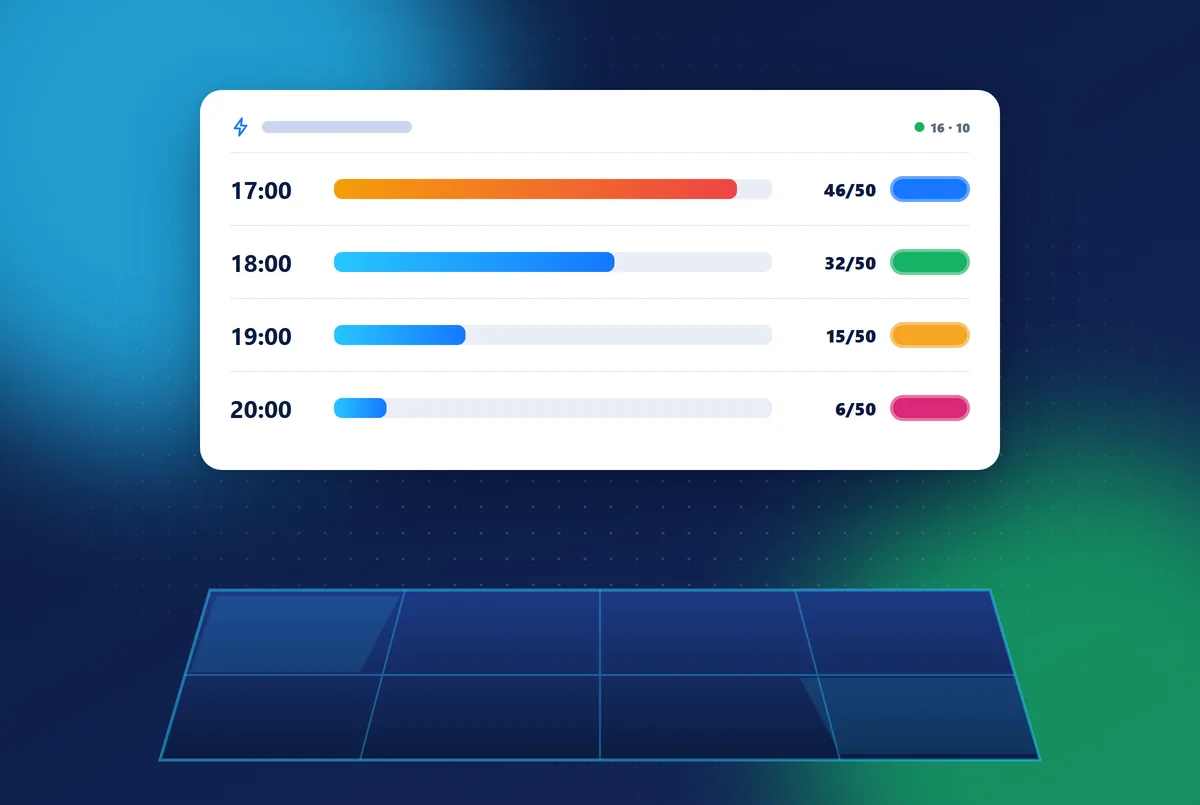
- Sessions with times, length and places: a full session is never sold, online or at the till.
- Grip socks and extras offered at booking and on the POS, which runs in the browser.
- Colour wristbands by entry time and a screen in the hall showing which colours finish.
- Parties with a shared invitation and a party sheet with sizes, food choices and allergies counted.
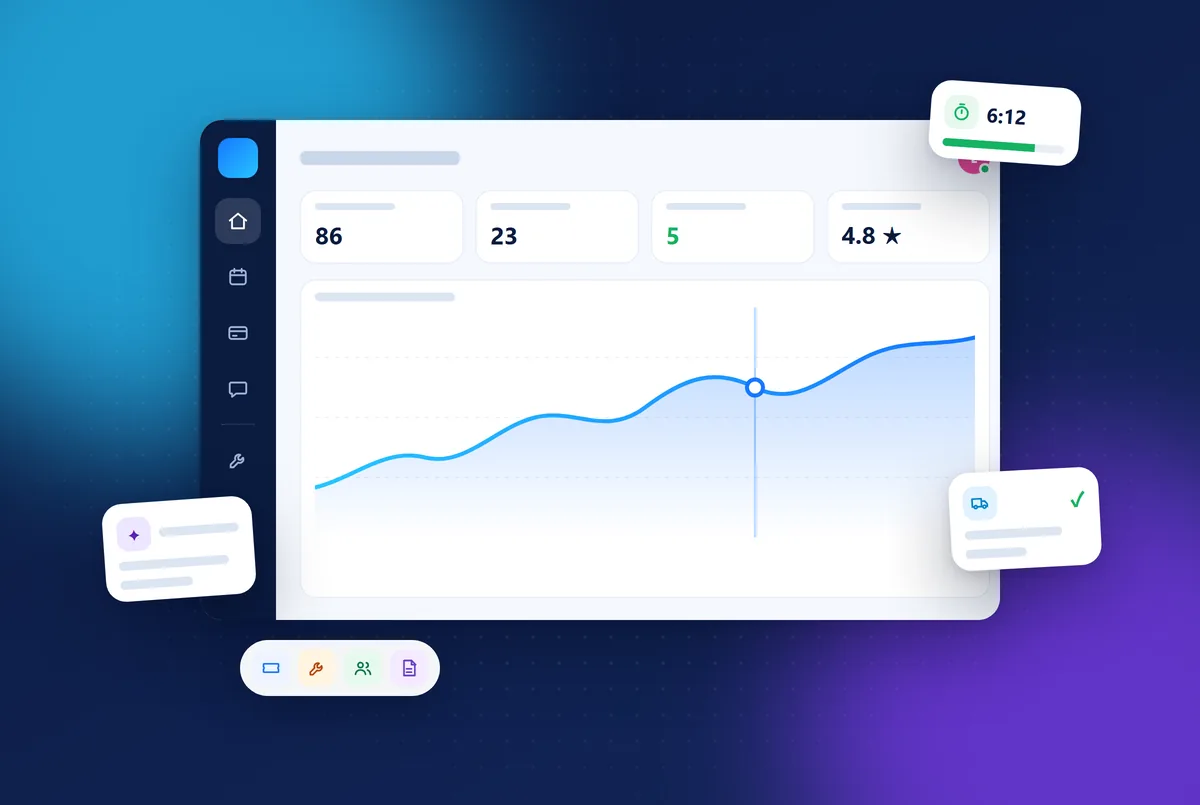
- A daily dashboard with sales, average ticket and bookings to compare your forecast with reality.
- As optional modules, digital waivers, staff clock-in and supplier orders.
You can see the rest in all features. And if you want to test it with your own offer before opening, start your 7-day free trial.