Kids birthday party packages that sell themselves
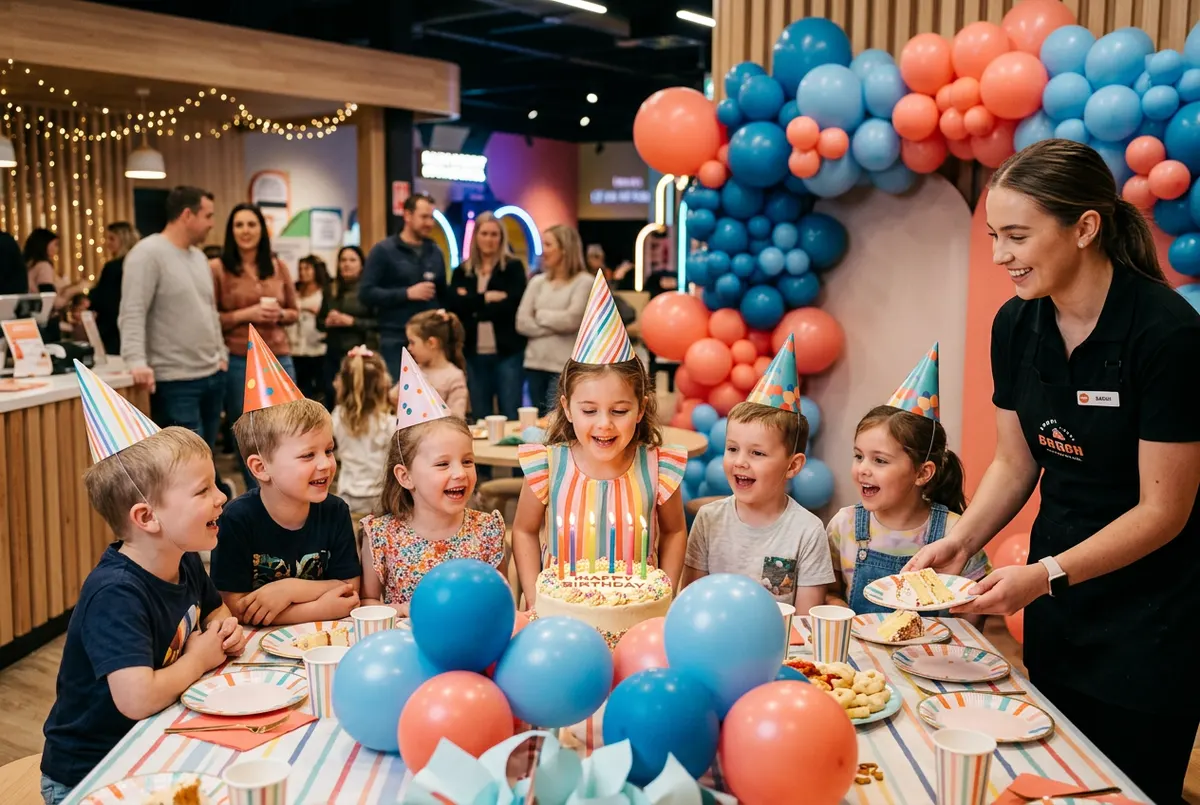
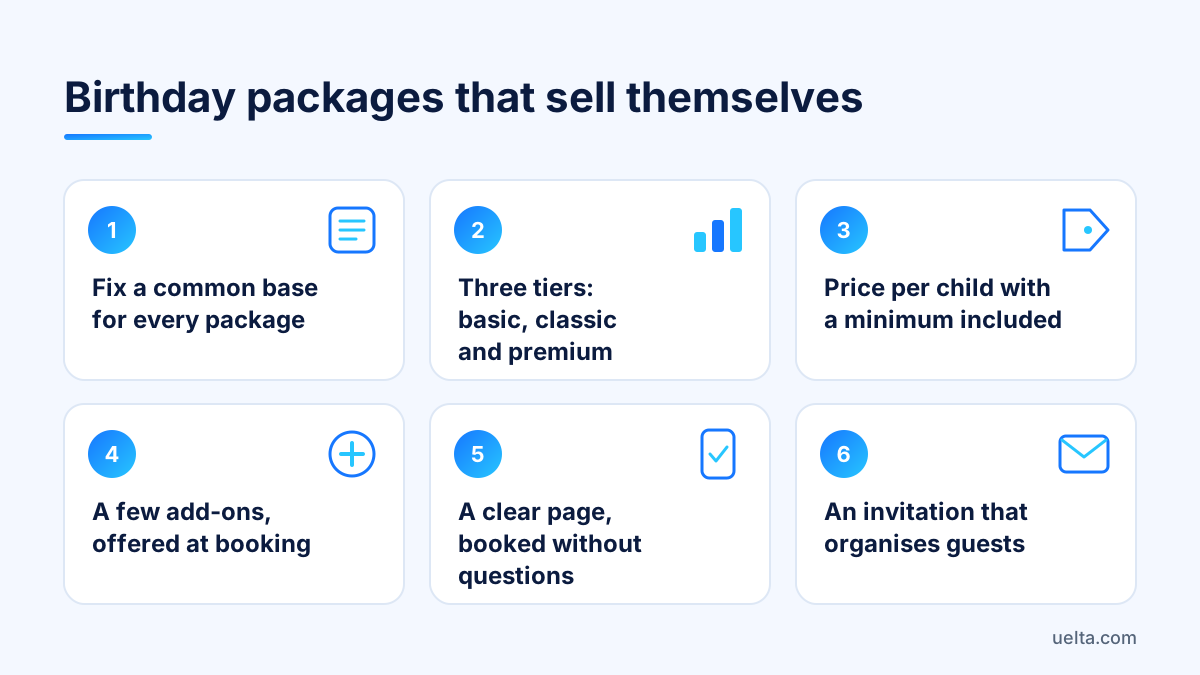
Kids birthday party packages sell themselves when parents can see within seconds what is included, how many children it covers, how long it lasts and what it costs, and can book and pay online without phoning. What works best in practice: three clear tiers, fixed contents, a few optional add-ons and an invitation that organises the guests for you.
What every birthday party package should include
Before you think about names or prices, define the base all your packages share. If something changes from one party to the next with no rule, staff improvise and parents start asking questions. Settle these points for every package:
- Duration: play time plus food time, for example 90 minutes of play and 30 minutes in the party room.
- Number of children: minimum included and maximum allowed. The minimum protects your margin; the maximum protects the room and your capacity.
- Space: private party room, reserved table or shared area. To parents, this is the most visible difference between packages.
- Party food: two or three menus to choose from, the drink included and the alternative for allergies.
- Party host: whether there is one, for how long and what they do.
- Kit and a treat: grip socks, wristband, invitation and something for the birthday child (a crown, a small gift or a special wristband), which is what children remember.
- Rules: ages, accompanying adults and whether outside food is allowed.
This list is your template: each tier is the same base with more or fewer items, not a different product.
Three tiers: the structure that helps parents decide
With one package, parents can only say yes or no. With seven, they freeze. Three tiers can be compared at a glance and, in practice, many families choose the middle one, so design that as the package you most want to sell.
- Basic: play, food in a shared area and a simple menu. It attracts price-conscious families and fills weekday gaps.
- Classic: private room, a host for the whole party, menu choice and a treat for the birthday child. This is your main package: give it the best photo.
- Premium: more time, a special activity or cake included. Fewer families buy it, but it makes the classic look sensible.
The difference between tiers should fit on one line (“private room”, “host for the whole party”) and each step must add something parents value, not just minutes. A catchy name such as “Bounce Party” sells better than “Package 1”, as long as the contents are clear underneath.
How to price kids birthday party packages
The price has to cover your real cost and make sense at first glance. Follow these steps:
- Work out the cost per child: food, socks, invitation and treat, plus the share of staff time and room time the party takes up.
- Choose the format: a price per child with a minimum included, which is clearest for parents, or a fixed price up to a set number of children with a supplement for each extra child.
- Space out the tiers: as a starting point, make each step 20% to 35% dearer and add something visible. If premium costs twice as much as basic without offering twice as much, hardly anyone will choose it.
- Vary by day and time: Saturday afternoon fills itself; Tuesday does not. A slightly lower weekday price spreads demand without touching the weekend price.
- Review every quarter: which tier sells most, which slots stay empty and which add-ons get chosen. If nobody buys basic, drop it; if everyone buys premium, it is underpriced.
Avoid permanent discounts, which teach parents to wait for the offer. A specific discount code for a campaign or for quiet slots works better.
Add-ons that raise the spend without complicating the package
Add-ons let each family personalise the party without multiplying your packages. Offer only a few, at the moment of booking rather than days later on the phone:
- Extra child above the minimum.
- Extra play time.
- Cake, piñata or sweet bags.
- Food or drinks for the adults.
- Themed decoration for the room.
Do not turn into an extra what everyone expects in the package: if children’s drinks are charged separately, parents will feel the advertised price was misleading.
The package page: booked without a single question
Every WhatsApp enquiry is a sale that has stalled. Check the page against this list:
- Name and one sentence summing up the party.
- What is included, in bullet points, with duration and number of children.
- Price per child and the minimum, with no small print.
- Available days and times on view.
- Recommended ages and basic rules.
- Food options and how you handle allergies.
- Date change and cancellation policy.
- A real photo of the room set up for a party.
Run a simple test: ask someone outside the venue to read the page on their phone and tell you what the package includes and what 15 children would cost. If they hesitate, information is missing.
Think about what happens after booking too. A package gets recommended when organising it is painless: the organiser should not have to chase other parents to find out how many are coming, what each child wants to eat or who has signed.
Mistakes that stall sales
- Too many options: five packages with variants and parents leave it for another day.
- “Price on request”: parents comparing several venues rule out the one that hides it.
- Uncontrolled slots: two parties in the same room, or a package sold when capacity is already full.
- Allergies on a scrap of paper: if the information does not clearly reach whoever serves the food, the risk is real.
- Contents depending on who is on shift: if one host gives extra time and another does not, the next family will expect the same.
Frequently asked questions
How many birthday party packages should I offer?
Three is usually the practical number: basic, classic and premium. Parents compare easily and your team always works to the same pattern.
Is it better to charge per child or a fixed price?
Per child with a minimum included is the easiest to understand and grows with the guest list. A fixed price suits venues whose parties are very consistent in size, always with a supplement per extra child.
What if more children turn up than were booked?
State the room’s maximum and the price per extra child on the package page, and charge the difference on the day. If guests sign up online, you know the numbers before the party.
How should I manage guests’ allergies?
Collect the information per child when each family confirms, and flag it clearly for whoever serves the food. Check your allergen and data protection obligations with a legal adviser.
How Uelta helps
In Uelta, each birthday package is a product with its own price, duration and VAT, sold in your online booking shop: customers only see days and times with space, add-ons are offered while booking, prices can vary by day or time and you can create discount codes. If you set up your private rooms as exclusive resources and say which ones each package uses, the system calculates occupancy for every hour and never sells more than fits.
With birthday parties, the organiser books the package online and shares the invitation link on WhatsApp. Each family takes a place, signs for their child, gives a sock size and picks food from the options you define, without needing an account. Your team gets the party sheet with sizes and menus already counted and allergies flagged with “!”. If places run out, the invitation says so and the organiser can extend the booking with the venue. See how it fits a kids’ party venue and, for other documents parents need to sign, such as image rights consent, use digital waivers.
Set up your three packages and a test party with the 7-day Uelta free trial.