Trampoline park session times: how to plan them

Trampoline park session times come down to three decisions: how long each session lasts, how often a new one starts and how many people can be on the court at once. Get those three numbers right, adapt them to weekdays, weekends and school holidays, and you will fill more slots without overloading the court or the front desk.
What a session is and why the timetable sets your capacity
A session is a time slot with a fixed start time, a fixed length and a maximum number of places. A trampoline park does not really sell an admission ticket; it sells a space on the court for a specific period. That makes the timetable the tool that controls how many people jump at once, how many queue at reception and how many staff you need on each shift.
A poorly designed timetable shows straight away: queues after school, empty courts mid-morning and marshals stretched thin when two parties overlap with a general session. A good one spreads arrivals, fits your wristband rotation and makes it obvious to customers what they can book.
Choosing the right session length
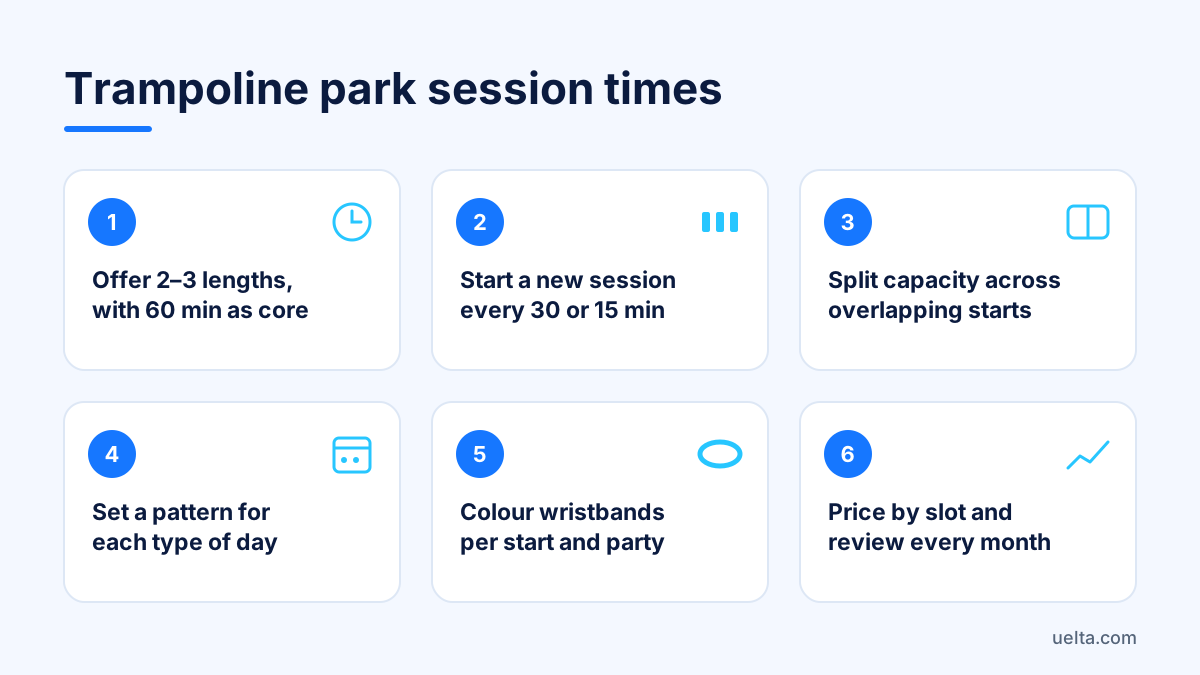
Many parks use 60 minutes as the standard general jump and offer 90 or 120 minutes as an option. When deciding, weigh up these criteria:
- Fatigue: jumping is intense. An hour is plenty for most children; longer sessions suit teenagers, adults or venues with other zones besides the trampolines.
- Turnover: the shorter the session, the more times the court refreshes on a busy day.
- Average spend: the longer session can work out slightly cheaper per minute than the short one, which nudges people towards it on quiet days.
- Simplicity: two or three lengths at most. More options complicate wristbands, the till and the customer's decision.
A practical approach: 60 minutes as your core product all year, 120 minutes on weekdays and during holidays, and the long session switched off at weekend peak times, when every place is worth more.
How often sessions start: block or staggered
There are two models, each with its own logic:
- Block sessions: everyone starts on the hour and leaves together. They are easy to explain and supervise, with a gap between sessions to check the court and repeat the safety briefing, but every arrival hits reception at the same moment.
- Staggered sessions: a new start every 30 minutes, or every 15 in larger parks. The front desk works at a steadier pace, although groups with different finish times share the court.
With staggered sessions, each start cannot be sold to the full capacity of the park. If sessions last 60 minutes and start every 30, two groups overlap on the court, so each one should take no more than half the total capacity. With starts every 15 minutes, four groups overlap and each gets a quarter.
Build in a buffer between arrival and jump time too. Ask customers to arrive 15 minutes early to collect wristbands, put on grip socks and hear the rules, and encourage parents to sign the waiver at home so the queue does not depend on a single tablet at reception.
Different timetables for different days
A single timetable for the whole year rarely works. Split your calendar into day types and set a pattern for each:
- Term-time weekdays: mornings for schools and groups, afternoons from the end of the school day.
- Weekends: earlier opening, staggered starts and capacity per start checked carefully.
- School holidays and half-term: the weekend pattern from Monday to Friday, with more weight on mornings.
- Bank holidays: treat them as a Saturday, whatever day they fall on.
Within each pattern you can set themed slots: toddlers with parents first thing, teens in the early evening, adult fitness or quieter sensory-friendly sessions with fewer jumpers and lower music. They work best when they repeat on the same day and at the same time every week.
Parties deserve their own slot. If they share the court with the general session, count party places within that slot's capacity and give them a wristband colour outside the rotation so staff can spot them. If you have party rooms, stagger party finish times so two groups do not meet in the corridor.
Pricing by slot: fill quiet hours without discounting peaks
Timetable and pricing go hand in hand. Once you know which slots fill and which do not, you can:
- Keep full price at weekend peak times.
- Offer a moderate discount, for example 10 to 20 per cent, on weekday mornings or the last session of the day.
- Set separate prices for bank holidays and school holidays.
- Use discount codes with dates and usage limits to boost a specific slot instead of cutting your general price.
Review occupancy by slot every month. If a session always sells out days in advance, raise its price slightly or add another start; if one is always half empty, move it or turn it into a themed session.
Checklist: setting your trampoline park session times
Go through this list before you open bookings. For an overview of how it fits with the rest of your operation, see our page for trampoline parks.
- Confirm the maximum number of jumpers per bed and per zone according to the manufacturer, the rules that apply to you and your insurer; if in doubt, check with an adviser.
- Set your standard opening hours and the exceptions: bank holidays, closures and school holidays.
- Choose two or three session lengths at most.
- Decide the start interval and divide total capacity between the groups that overlap.
- Assign a wristband colour to each start and keep special colours for parties and unlimited time.
- Block out slots for groups, schools and parties.
- Set prices by day type and by slot.
- Publish the same timetable on your website, your Google listing and social media.
- Plan staffing around expected arrivals, not just capacity.
- Review the figures every month and adjust.
Frequently asked questions
How long should a trampoline park session be?
Many parks use 60 minutes as the main session and offer 90 or 120 minutes as an option. An hour is usually enough for children and lets the court turn over more often on busy days.
How often should trampoline park sessions start?
Every 30 minutes is a good starting point because it spreads arrivals at reception without making supervision too complex. Larger parks can move to every 15 minutes if they divide capacity between the overlapping groups.
How do I work out capacity per session?
Start from the maximum number of people allowed on the court at once and divide it by the number of groups that overlap. With 60-minute sessions starting every 30 minutes, each start should take no more than half the total.
What booking software lets parents sign waivers for their children before arriving at a trampoline park?
Look for software that links session bookings to the waiver, so the adult signs for their children from a phone and reception can see who is still missing. Uelta does this through the link in the booking email or a QR code at reception.
How Uelta helps
With Uelta's online booking, each product has its own times, length and places, and customers only see the days and times that still have space, so you never sell more than fits. You can set different prices by day or hour, mark special days and create discount coupons. If you allow it, customers change the date themselves from their account.
With wristbands and capacity you set colours that rotate by entry time and length, special wristbands for parties or unlimited time, and the capacity of each zone per session. The till shows which colour to hand out when taking payment, and a screen on the floor shows which colours are finishing. Waivers are signed by phone too, including for children, and on arrival the till shows who has signed and who has not.
If you want to build your session timetable with real data, start your free Uelta trial.